Aomori Nebuta Festival Official Guidebook Review: What’s Inside the ¥440 Booklet?
With the Aomori Nebuta Festival approaching once again, the official guidebook has started appearing in local bookstores.
It costs just ¥440.
In this article, I will show you what is inside and whether it is worth buying.
This guidebook is already well worth the price for two reasons:
- It covers the basic information about the festival, including its schedule, history, and how the floats are made.
- It contains the preliminary sketches for this year’s Nebuta floats.
Unfortunately, however, this excellent guidebook does not have a complete English edition.
What a shame! Come on, Aomori—you can do better!
Even so, I still recommend buying it. It is inexpensive, enjoyable as a visual book filled with Nebuta sketches, and makes an affordable souvenir. If you really want to read the Japanese text, you can also use a translation app.
If you are planning to see the Aomori Nebuta Festival in person, I hope this review helps.
Size and appearance
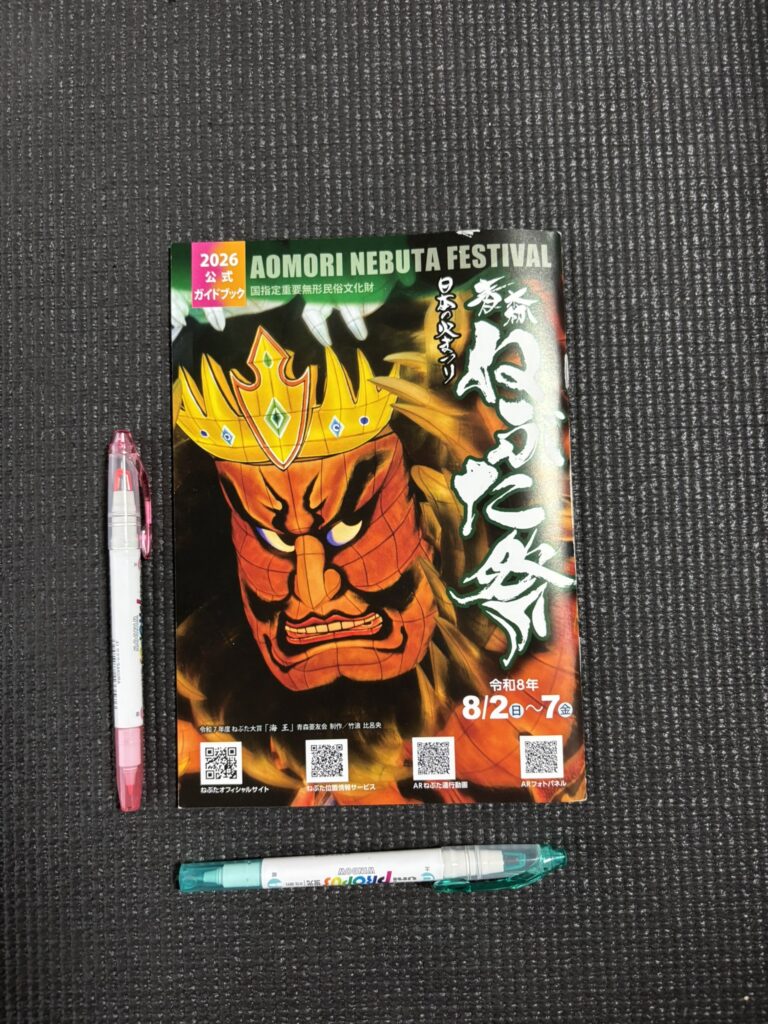
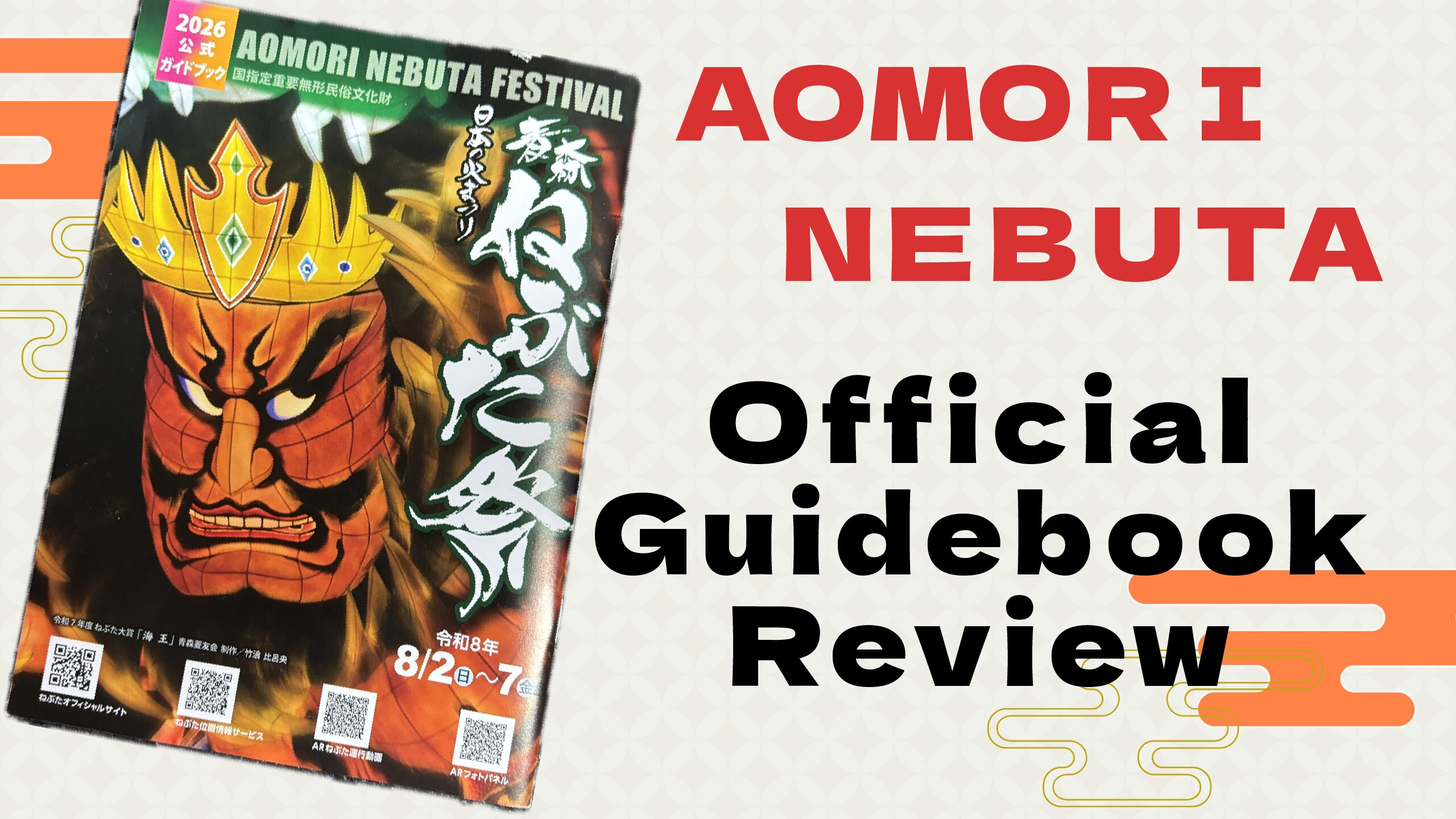
The guidebook measures approximately 21 centimeters tall and 15 centimeters wide.
It has 40 pages, including the covers, and is thin and small enough to slip into a small shoulder bag.
The cover features the float that won the Nebuta Grand Prize—the festival’s highest award—in 2025.
It was created by Hiroo Takenami, my favorite Nebuta artist.
Take a moment to admire its sharp, beautiful, yet fierce gaze.
What is inside the guidebook?
1. The origins of Nebuta
This section explains where the name “Nebuta” came from and how the festival began. It also describes the festival as having a history dating back to around 1716.
This is the only section that includes an English translation. After this, the guidebook is entirely in Japanese.
2. The parade route and schedule
The Aomori Nebuta Festival is held every year from August 2 to 7, but the starting locations and parade times differ depending on the day.
The guidebook explains these differences with maps and diagrams. Unfortunately, because there is no English translation, this section may be difficult for international visitors to understand.
However, times are written using numbers, such as:
2–6日: 18:45–20:10
This means that visitors can at least understand the approximate times. Incidentally, the Japanese character 日 means “day” or indicates a date.
The guidebook also lists the participating Nebuta groups. Some floats do not appear every day, so check the schedule if there is a particular one you want to see.
Fortunately, an English-language festival guide map is available for free on the official website. I recommend using the two together: this booklet for the detailed themes and sketches, and the English map for the schedule and parade route.
2026 Aomori Nebuta Festival Guide Map
If you want to see as many large, colorful Nebuta floats as possible, I recommend visiting from August 4 to 6, when around 20 large floats are scheduled to appear.
August 6 is particularly recommended because the festival awards are announced, and you can see the prize-winning floats displaying their award plaques.
If you want to enjoy both Nebuta and fireworks, visit on August 7.
On August 2 and 3, large Nebuta floats appear alongside smaller children’s Nebuta floats. Watching the children pull their adorable floats is charming in its own way.
3. Introduction to the Nebuta artists
This section contains photographs of the artists who create the floats, along with information about their careers and awards.
You can use it to discover the artist behind your favorite float.
My personal favorite is Hiroo Takenami.
4. Participating groups and float themes
Nebuta floats are often based on historical figures, mythology, Japanese folktales, Chinese stories such as Romance of the Three Kingdoms, and other traditional tales.
This section provides a short summary of each theme. Some artists also explain the main features and highlights of their designs.
You can look at a sketch while watching the completed float move through the streets and think, “So this is what that drawing became!”
Alternatively, you can see the finished float first and examine its original sketch afterward.
I highly recommend carrying this guidebook with you and comparing the sketches with the real floats during the festival.
You can also see last year’s Nebuta on the official festival website. If you want an idea of what the illustrations and completed floats look like, check the link below.
Official Aomori Nebuta Festival Archive: 2025
5. How a Nebuta float is made
This section explains the order of the parade procession—including the Nebuta float, Haneto dancers, and musicians—and shows how a float is created through photographs.
It also has a Q&A section answering basic questions, such as how long it takes to make a Nebuta float and how much one float costs.
6. Last year’s award-winning floats
This section includes photographs of the floats that won the Nebuta Grand Prize and other awards in the previous year.
7. Other information
The guidebook also explains how to participate as a Haneto—one of the dancers who jump and dance during the Nebuta parade.
Where I bought the guidebook
I bought my copy at Narita Honten’s Shinmachi store.
The bookstore is close to the Nebuta parade route, so it is a convenient place to buy the guidebook while waiting for the parade to begin.
You can find plenty of copies immediately to the left after entering the store.
Last year, the Narita Honten store inside Sunroad Aomori also stocked the guidebook.
Final thoughts
The official guidebook contains a surprising amount of information for only ¥440. It is inexpensive, compact, and easy to carry, making it a good souvenir as well as a useful companion for comparing the original sketches with the completed floats during the festival.