What does “Zawa-Zawa” really mean in Japanese manga?
Onomatopoeia in Japanese manga can express not only sounds, but also emotions and situations.
In this series, I introduce them one by one with real examples, as a Japanese person who has loved manga for over 30 years and also holds a teaching license in Japanese language arts.
This time, it’s “zawa-zawa.”
“Zawa-zawa” is not just the sound of people making noise.
In Japanese manga, it is a very useful and often unsettling onomatopoeia used when the atmosphere starts to shift, when people become confused by something unusual, or when an invisible sense of unease begins to creep closer.
And that is what makes this word so interesting: it is not just about “noise.”
It can also express the moment when a crowd has not yet decided whether to agree or object, when someone’s heart feels strangely unsettled, or when the air itself seems to warn that something bad is about to happen.
In this article, I’ll explain when “zawa-zawa” is used, how it expresses crowd reactions and emotional unease, and what changes when it appears as “zawa…” “zawa-zawa…” or even in katakana as “ZAWA-ZAWA.”
This article is for people who:
・want to understand the meaning of onomatopoeia in Japanese manga
・want to understand the uneasy and unsettling nuance of “zawa-zawa”
・are curious about how manga expresses crowd tension, emotional unrest, and ominous atmosphere
1. The basic meaning
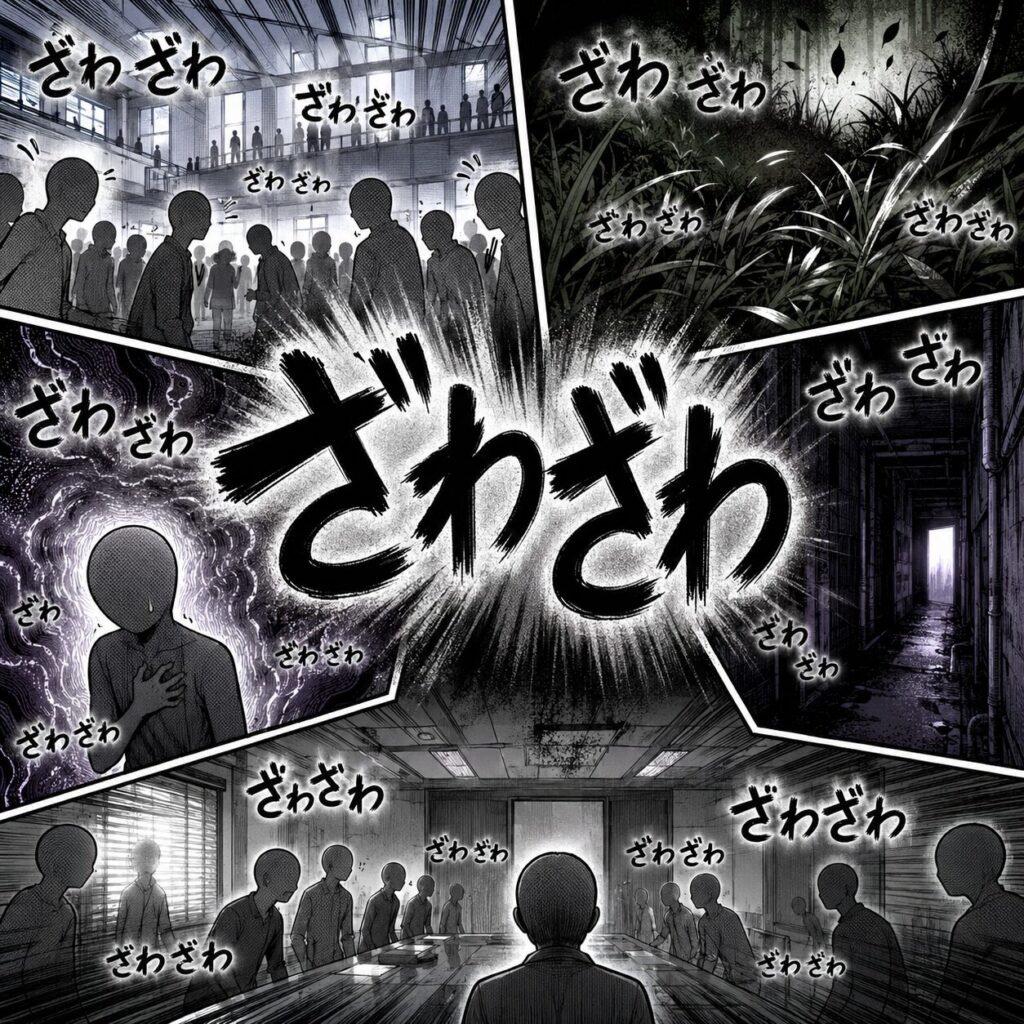
Zawa-zawa is an onomatopoeia that can describe the murmur of people, the rustling of grass or leaves, and the uneasy feeling of a restless heart.
It does not simply mean “a noisy sound.”
In many cases, it is used for a kind of disturbance that carries uncertainty, confusion, or unease—when something feels wrong, but its true shape is still unclear.
In other words, zawa-zawa often suggests that:
- the atmosphere is unsettled
- people around you are disturbed
- your heart is no longer calm
- something bad may be about to happen
2. Common situations
1) When people begin to murmur
This is one of the most basic uses of zawa-zawa.
It can appear in places like schools, shopping malls, meetings, or crowds—situations where many people begin talking at once.
But in manga, zawa-zawa is not used only because a place is crowded or loud.
It often appears when one person suddenly says something outrageous, strange, or completely outside normal expectations, and the people around them do not know how to react.
For example:
“From today on, no one shall eat using their hands! This is the king’s command!”
If someone suddenly said something like that, the crowd would not immediately know whether to accept it or reject it.
That moment of uncertainty is exactly where zawa-zawa appears.
This is important: zawa-zawa is not the final reaction.
It is the stage before the conclusion.
At that point, people are still thinking:
- What is he talking about?
- Is he serious?
- Is that even possible?
- …but wait, what if he has a point?
If the hero explains himself well and the crowd is convinced, the scene may later turn into loud cheers like “Waaah!”
If the explanation fails, it may turn into boos instead.
So zawa-zawa often represents the moment before the crowd fully decides—the point where the atmosphere is shaking, but the answer has not formed yet.
That is one of the most interesting things about this word.
2) When unseen unease begins to approach
Zawa-zawa can also be used for nature or movement, not just people.
For example:
- grass in a forest starts to move
- something seems to be getting closer
- but you still cannot see it
- so the fear grows before the danger is visible
In scenes like this, zawa-zawa is not just a sound effect.
It carries fear of something unseen.
And this is where the visual form becomes especially important.
In more horror-like scenes, the word may shift from hiragana ざわざわ to katakana ザワザワ.
That change matters.
The hiragana version still has a slightly softer feel.
But once it becomes ザワザワ, that softness is stripped away, and the word starts to feel much more ominous and foreboding.
So even though the sound is the same, the script can change the atmosphere:
- ざわざわ = softer unease, disturbance, restlessness
- ザワザワ = stronger menace, stronger dread, a darker omen
This is one of those manga-specific effects that makes the word even more powerful.
3) When the heart feels unsettled
Zawa-zawa can also describe a person’s inner state.
For example:
“My heart feels zawa-zawa. I feel like something bad is going to happen.”
In this kind of sentence, zawa-zawa feels like your heart has been lightly brushed the wrong way—almost like fur being stroked backward.
Nothing definite has happened yet.
But something feels off.
Your usual emotional balance is gone, and your mind is no longer calm.
In these cases, zawa-zawa is less about clear fear and more about:
- unease
- discomfort
- confusion
- a bad feeling
- a sense that something is coming
What matters here is that the feeling has not yet fully taken shape.
4) When a feeling is disturbed, but not yet love
In rarer cases, zawa-zawa can be used for feelings that are not exactly fear—and not quite romance either.
This is different from words like doki or kyun, which are much more clearly tied to romantic emotion.
Instead, zawa-zawa can describe a state like:
- I don’t know why, but I feel unsettled
- I can’t stop noticing this person
- I don’t feel like my usual self
- my feelings are disturbed, but I still can’t explain them
So in this kind of scene, zawa-zawa does not mean “This is love!”
It means something more vague and unstable:
the heart is no longer in its normal state.
That is what makes it so interesting.
3. Similar expressions and differences
Zawa-zawa vs. moya-moya
These two can look similar at first, but they are different.
- zawa-zawa = restlessness, unease, a disturbed atmosphere, inner or outer instability
- moya-moya = something unclear, vague dissatisfaction, a cloudy feeling you cannot put into words
Zawa-zawa works better for things like:
- disturbed air
- crowd reactions
- ominous signs
- emotional unrest
Moya-moya is quieter and more internal, like a fog that stays inside your mind.
Zawa-zawa vs. doki-doki
- zawa-zawa = unease, confusion, foreboding, emotional unrest
- doki-doki = a pounding heart, strong excitement, nervousness, tension
Doki-doki feels closer to the heartbeat itself.
Zawa-zawa, on the other hand, feels more like the whole atmosphere or emotional state is being disturbed.
Why does manga sometimes write it as “zawa…”?
In manga, zawa-zawa is sometimes shortened to forms like:
- zawa…
- zawa… zawa…
When it is written like this, it often creates the feeling that the unease is spreading slowly through the air.
Rather than one big loud sound, it feels like the atmosphere itself is gradually breaking apart.
This is why the expression is so effective in crowd scenes, suspense, and psychological tension.
The famous “zawa… zawa…” in Kaiji is a good example: it works less like a simple sound effect and more like a visual way of showing collective unease.
4. Nuance and effect in manga
The most important feature of zawa-zawa is this:
Nothing final has happened yet, but the atmosphere is already falling apart.
That is the key.
For example:
- a crowd is confused
- the mood has been shaken by something abnormal
- something unseen seems to be approaching
- the heart feels strange for no clear reason
- the air itself feels wrong
When zawa-zawa appears in a manga scene like this, the reader immediately starts to brace for what comes next.
So zawa-zawa does not describe the event itself.
It describes the unease, distortion, and instability that spread before the event becomes clear.
And what makes the word especially rich is that it can carry more than simple fear.
It can also hold:
- confusion
- hesitation
- a sense of warning
- mild anger
- the crowd’s uncertainty
- the heart’s disturbance
That is why zawa-zawa works in horror, suspense, crowd scenes, and psychological moments alike.
It is a surprisingly wide and flexible onomatopoeia.