What Does “Kira-Kira” Mean in Japanese Manga?
Onomatopoeia in Japanese manga can express not only sounds, but also emotions and situations.
In this series, I introduce them one by one with real examples, as a Japanese person who has loved manga for over 30 years and also holds a teaching license in Japanese language arts.
This time, it’s “kira-kira.”
“Kira-kira” is not just a word used when something is physically shining.
In Japanese manga, it can describe not only the sparkle of stars, jewels, or water, but also hopeful eyes, a dazzling smile, or the moment when someone you like seems to shine.
But what makes kira-kira interesting is that it is not always just a simple compliment.
It can suggest admiration, like the glow of a star or idol. It can describe an idealized youth, a person who seems too bright to approach, or even carry a slightly ironic nuance, as if to say, “They look shiny, but is there anything real underneath?”
In this article, I’ll explain when “kira-kira” is used, why it can describe people and idealized images, and how it differs from “gira-gira” and “kira.”
This article is for people who:
・want to understand the meaning of onomatopoeia in Japanese manga
・want to understand the bright, dazzling nuance of “kira-kira”
・are curious about how “kira-kira” can describe people, smiles, and idealized youth
1. The basic meaning
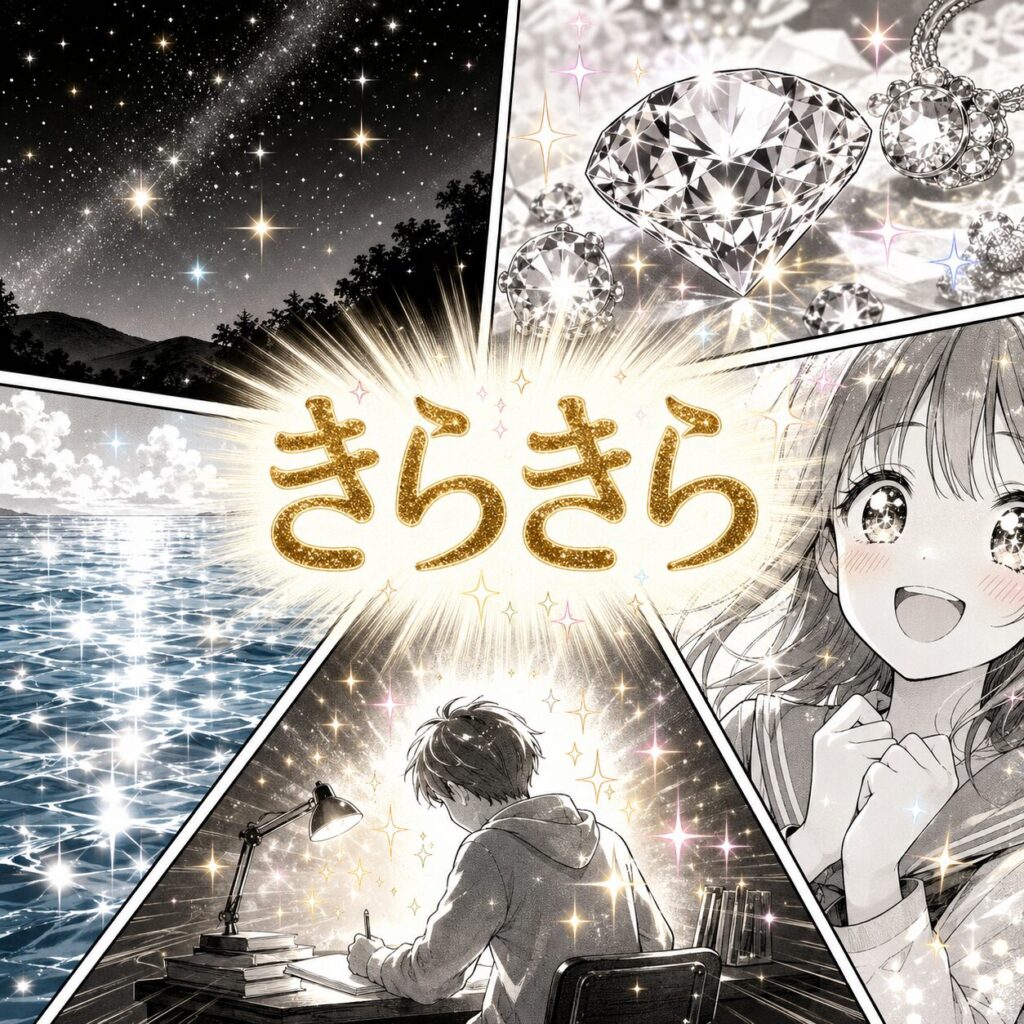
Kira-kira is a Japanese onomatopoeia that describes something shining or sparkling brightly, such as stars, jewels, water, eyes, or a smile.
In English, it is close to the word “twinkle” in “Twinkle, Twinkle, Little Star.”
But kira-kira does not simply mean “shiny.”
It can also suggest:
- a light, beautiful sparkle
- beauty
- hope
- purity
- brightness
- an idealized image
- the feeling that someone looks radiant
It is often used for things like:
- stars
- jewels
- gold
- beads
- Swarovski crystals
- diamonds
- water surfaces
- eyes
- smiles
- someone you like
- idols or stars
In short, it is very close to the feeling of ✨
2. Common situations
1) When stars, jewels, or water are shining
The easiest use to understand is when something is physically shining.
For example:
- stars shining in the sky
- jewels sparkling
- light reflecting on the surface of water
- gold or beads glittering
- accessories catching the light
In these situations, kira-kira feels natural.
This kind of kira-kira is not a harsh light that hurts your eyes.
It is more like a small, light, beautiful sparkle.
2) When someone’s eyes or smile shine
Kira-kira is also often used for people’s expressions.
It especially fits:
- a child’s trusting eyes
- eyes full of hope
- an innocent smile
- a dreamy expression
For example, imagine an adult who has to take a child to get a vaccination.
The adult only says:
“We’re going out.”
The child, suspecting nothing, happily says:
“Yay!”
with kira-kira eyes.
The adult sees that innocent, shining look and thinks:
“Ugh… too bright…!”
In this case, kira-kira does not simply mean that the child’s eyes are physically shining.
It shows a brightness made of trust, innocence, hope, and purity.
In other words, kira-kira can describe a pure brightness so strong that it almost burns the adult’s sense of guilt.
3) When someone you like looks radiant
This is a very important use.
Kira-kira can describe a moment when someone does not literally shine, but looks radiant because you like them.
For example:
- the person you like playing sports
- the person you like studying seriously
- the moment they smile casually
- the way they walk
- even an ordinary action that would not seem special to anyone else
When you are attracted to someone, even their normal behavior can look kira-kira.
So in this case, kira-kira is not physical light.
It is the sparkle created by the viewer’s feelings.
This means kira-kira can describe not only the shine of the object itself, but also the way affection or admiration makes someone appear radiant.
4) A kira-kira person
There is also the expression “a kira-kira person.”
This does not simply mean someone wearing shiny clothes or accessories.
It means that the person themselves seems to shine.
For example:
- stars
- idols
- people working hard toward their dreams
- people enjoying their youth
- people who seem to be moving forward positively in life
However, this kind of kira-kira can also create a little distance.
The person shines.
But that does not always mean they are easy to approach.
When someone says:
“That person is so kira-kira.”
there may be a feeling of:
They are too bright.
They seem like someone from another world.
They are a little hard to get close to.
So kira-kira can also carry a sense of distance.
5) Kira-kira youth and kira-kira adulthood
Kira-kira can also be used for an idealized image, not just reality.
For example, kira-kira youth might bring to mind things like:
- falling in love
- fighting with friends
- joining club activities
- going shopping after school
- eating with friends after class
It is the kind of image that feels like a full set of idealized youth.
In a way, it is a bundle of romanticized desires.
Similarly, a kira-kira working adult might suggest someone who:
- leaves work on time
- gets a good bonus
- travels on weekends
- gets along with their boss
- has both work and private life under control
So kira-kira can create a bright, idealized image of life.
It is not always about reality.
Sometimes it is about the shining version of reality people imagine.
6) Kira-kira as irony
Kira-kira is not always purely positive.
For example, the phrase:
“That person is so kira-kira.”
can sometimes sound a little ironic, depending on the context.
It may suggest:
- they are too dazzling to approach
- they look glamorous only on the surface
- they seem ideal, but maybe not real
- they feel like someone from a different world
- they are a little irritatingly perfect
So kira-kira can be a compliment, but it can also carry a question like:
“They look shiny, but is there anything real underneath?”
That is one of the interesting parts of this word.
3. Similar expressions and differences
Kira-kira vs. gira-gira
This comparison is very important.
- kira-kira = light, beautiful sparkle; hope; purity
- gira-gira = harsh brightness; desire; pressure; aggressive glare
Kira-kira is a beautiful kind of shine.
It fits stars, jewels, eyes, smiles, and other mostly positive images.
Gira-gira, on the other hand, feels stronger and a little frightening.
It can be used for:
- eyes full of desire
- harsh sunlight
- obvious ambition
- a greedy or intense expression
Simply put:
Kira-kira is the light of admiration.
Gira-gira is the light of desire.
Kira-kira vs. kira
Kira or kira’ describes a brief flash of light.
For example:
- teeth flashing for a moment
- a ring catching the light
- eyes shining for an instant
Kira-kira, on the other hand, describes a shine that continues for a while, or an overall sparkling impression.
So:
- kira’ = a momentary flash
- kira-kira = continuous sparkle or an overall shining impression
I think kira’ could be its own article later.
In this article, it is enough to mention it briefly as a comparison.
4. Nuance and effect in manga
The key point of kira-kira is that it is not just light.
It is light wrapped in beauty, hope, admiration, or idealization.
When kira-kira appears in manga, readers may feel:
- this is something beautiful
- this person is full of hope
- this expression is innocent
- the person someone likes looks radiant
- this world is being idealized
- but maybe it is a little too bright
Kira-kira also works very well in children’s magazines, children’s manga, and works for younger readers.
That is because it can instantly create an impression of:
brightness, cuteness, beauty, and dreams.
But in more adult contexts, kira-kira can sometimes become slightly ironic.
So this word can include many different layers:
- truly beautiful sparkle
- pure hope
- the feeling that someone you like looks radiant
- idealized youth
- star-like presence
- surface-level glamour
- a brightness that creates distance
That is why kira-kira is a surprisingly wide and flexible onomatopoeia.
FAQ
Q1. Does “kira-kira” mean “sparkle,” “twinkle,” or “glitter”?
It is close, but not exactly the same.
Kira-kira is used for light like stars or jewels, so in English it can be close to sparkle, twinkle, or sometimes glitter.
However, Japanese kira-kira is not limited to physical light.
It can also describe eyes, smiles, a person’s atmosphere, someone you like looking radiant, youth, or an idealized image.
So it does not simply mean “shiny.”
It can also express a bright, beautiful impression or a hopeful atmosphere
Q2. Can “kira-kira” describe people, or only shiny objects?
Kira-kira can describe people too, not only shiny objects.
For example, you can say:
- kira-kira eyes
- a kira-kira smile
- a kira-kira person
- someone you like looking kira-kira
The important point is that the person is not literally shining.
Someone you like or admire can look radiant when they are playing sports, studying, smiling casually, or even doing something ordinary.
In other words, kira-kira can describe not only a person’s own charm, but also the sparkle created by the viewer’s affection or admiration.
Q3. Is “kira-kira” always a compliment?
Most of the time, kira-kira is used positively.
For example:
“a kira-kira smile”
“kira-kira eyes”
“kira-kira youth”
These expressions usually feel bright and beautiful.
However, depending on the context, kira-kira can also sound a little ironic.
If someone says:
“That person is so kira-kira.”
it may include a sense of distance, such as:
They are too dazzling.
They feel like someone from a different world.
They look glamorous only on the surface.
So kira-kira can express beautiful brightness, but it can also suggest discomfort toward something that feels too idealized.
Q4. What are “kira-kira names” in Japanese?
Kira-kira names are Japanese names that stand out more than usual, often because the kanji are difficult to read in the expected way.
In Japanese, kanji usually have certain established readings.
But with kira-kira names, the reading may be based more on the image or meaning of the kanji, or kanji may be forced onto a sound that does not naturally match them.
Because of that, it can be difficult to know how to read the name just by looking at the kanji.
Sometimes you have to ask the person directly.
To be honest, kira-kira name is not usually used in a very positive way.
It can mean “unique” or “eye-catching,” but it can also carry a critical nuance, such as:
hard to read, too flashy, or outside common naming conventions.
In this case, kira-kira does not mean beautiful sparkle like a jewel.
It is closer to the idea of something being noticeable, flashy, unusual, or a little excessive.