What does “Waku-Waku” really mean in Japanese manga?
Onomatopoeia in Japanese manga can express not only sounds, but also emotions and situations.
In this series, I introduce them one by one with real examples, as a Japanese person who has loved manga for over 30 years and also holds a teaching license in Japanese language arts.
This time, it’s “waku-waku.”(わくわく)
“Waku-waku” is not just a word for saying “I’m excited!”
In Japanese manga, it is an onomatopoeia that expresses the feeling of looking forward to something fun, or that eager, bubbling emotion that spills over into someone’s eyes, face, and body before the fun even begins.
In this article, I’ll explain when “waku-waku” is used, why it is often linked to childlike purity and openness, and how it differs from “doki-doki.”
This article is for people who:
・want to understand the meaning of onomatopoeia in Japanese manga
・want to know what kind of feeling “waku-waku” expresses
・want to understand the nuance of “waku-waku” in Japanese manga
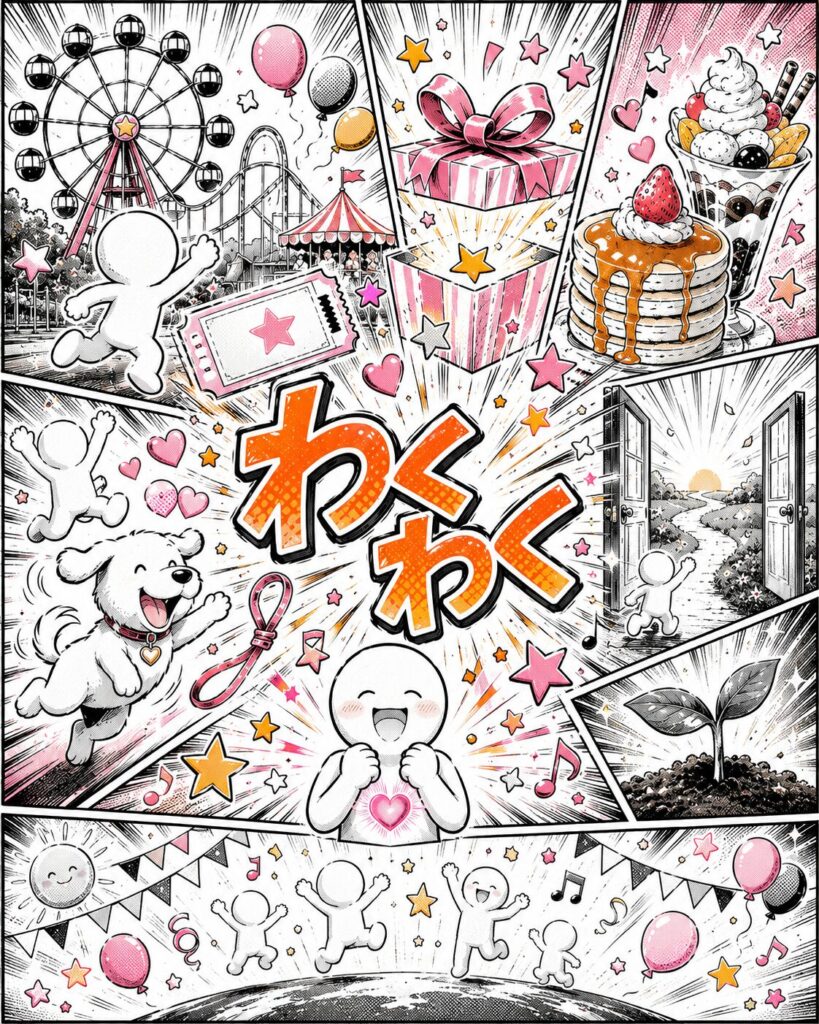
The basic meaning
Waku-waku is an onomatopoeia that describes the feeling of your heart lifting with excitement.
It does not simply mean “I’m looking forward to it.”
It has a stronger sense of cheerful anticipation, as if that feeling is already starting to show in your body, your expression, and even the sparkle in your eyes.
One important point is that waku-waku often describes the feeling before something fun begins, rather than the fun itself.
Common situations
Before something fun happens
This is the most common use of waku-waku.
It often appears when someone is looking forward to something enjoyable, such as:
- going to an amusement park
- eating something special
- opening a present
- going to a festival or event
For example:
“We’re going to the amusement park tomorrow!” → waku-waku
“Can I really eat all of this?” → waku-waku
In these kinds of scenes, the feeling is not quiet or hidden.
It is more like “I’m so excited that my feelings are already spilling out.”
Showing childlike purity and openness
Waku-waku goes especially well with characters who are childlike, innocent, or emotionally straightforward.
That is why it often fits:
- children
- mascot-like characters
- innocent animals
- simple, pure-hearted characters
Even dogs can be described as waku-waku before a walk or before food.
This word can show not only that a character is excited, but also what kind of things make them light up.
In that sense, waku-waku is useful because it reveals a character’s interests, their emotional honesty, and their sense of wonder.
Hope and positive expectation
Waku-waku is not limited to small daily pleasures.
It can also describe the feeling of moving toward something better:
- starting something new
- heading toward a brighter future
- feeling hopeful about what comes next
In those cases, waku-waku is not just about being excited.
It also carries a sense of bright hope and positive energy.
Used outside manga too
Waku-waku is not only used in manga.
It also appears in:
- children’s posters
- event advertisements
- class names
- promotional materials
For example:
- Waku-Waku Computer Class
- Waku-Waku Event
In these cases, the word creates a feeling of:
“Something fun is waiting for you.”
That is why it works so well in friendly advertising, especially when the goal is to sound bright, approachable, and easy to enjoy.
The difference between waku-waku and doki-doki
These two expressions are sometimes used together, but they do not mean quite the same thing.
- waku-waku = cheerful excitement and positive anticipation
- doki-doki = a pounding heart caused by excitement, nervousness, tension, or emotion
So waku-waku is mainly bright and hopeful.
Meanwhile, doki-doki can also include:
- nervousness
- romantic tension
- anxiety
- emotional excitement
For example:
- before a school trip → waku-waku
- before seeing someone you like → doki-doki
- before a fun but nerve-wracking event → waku-waku doki-doki
So while they can overlap, waku-waku feels lighter, brighter, and more openly joyful.
Nuance and effect in manga
The biggest feature of waku-waku is that the excitement is no longer hidden.
It is not just a thought in someone’s head.
It has already started to appear in their face, their eyes, and the way they move.
When waku-waku appears in manga, readers can often feel:
- this character is genuinely interested in something
- this person is innocent or emotionally open
- something fun is about to happen
It is also a useful word for showing what kind of things a character loves.
That is why waku-waku is more than just “excitement.”
It often creates a feeling of open, overflowing anticipation.
FAQ
Q1. Does “waku-waku” mean the same thing as “excited” in English?
Not exactly.
In many cases, “excited” is close, but waku-waku has a stronger sense of looking forward to something fun. It often carries a bright, hopeful feeling, like “I can’t wait” or “I’m really looking forward to it.”
So waku-waku is not just about strong emotion. It often describes the cheerful anticipation you feel before something enjoyable happens.
Q2. Is “waku-waku” a childish expression? Can adults use it too?
It does have a slightly childlike feel, but adults can definitely use it too.
In more formal situations, expressions like “I’m looking forward to it” or “I’m eagerly waiting for it” are usually safer.
That said, adults do use waku-waku in casual conversation. For example, I might say to a friend or a close coworker:
“I’m going to a concert this weekend, so I’m already feeling waku-waku.”
So it is not a word that only children use. It simply gives off a more open, playful, and innocent feeling.
Q3. Why is “waku-waku” often used in children’s advertising and for cute characters?
Just by being written in hiragana, waku-waku already feels soft and friendly.
It also appears often in picture books and children’s media, so it is a very easy and familiar way to express emotion from an early age.
Because of that, when people see the word waku-waku, they tend to immediately feel something fun, bright, and approachable.
That is why it works so well in children’s advertising and with cute characters: it can express a warm, easy-to-understand sense of excitement in just one word.