What does “Doki” mean in Japanese manga?
Onomatopoeia in Japanese manga can express not only sounds, but also emotions and situations.
In this series, I’ll introduce them one by one with real examples, as a Japanese person who has loved manga for over 30 years and also holds a teaching license in Japanese language arts.
“Doki”(どきっ) is not just the sound of a heartbeat.
In Japanese manga, it is an important onomatopoeia that captures the exact moment when someone’s heart suddenly reacts—such as when love begins, or when someone is flustered after being hit with the truth.
In this article, I’ll explain when “doki” is used, why it is so important in romantic scenes, and how it differs from “doki-doki.”(どきどき)
This article is for people who:
・want to understand the meaning of onomatopoeia in Japanese manga
・want to know how “doki” is used in romantic expressions
・are curious about the difference between “doki” and “doki-doki”
The basic meaning
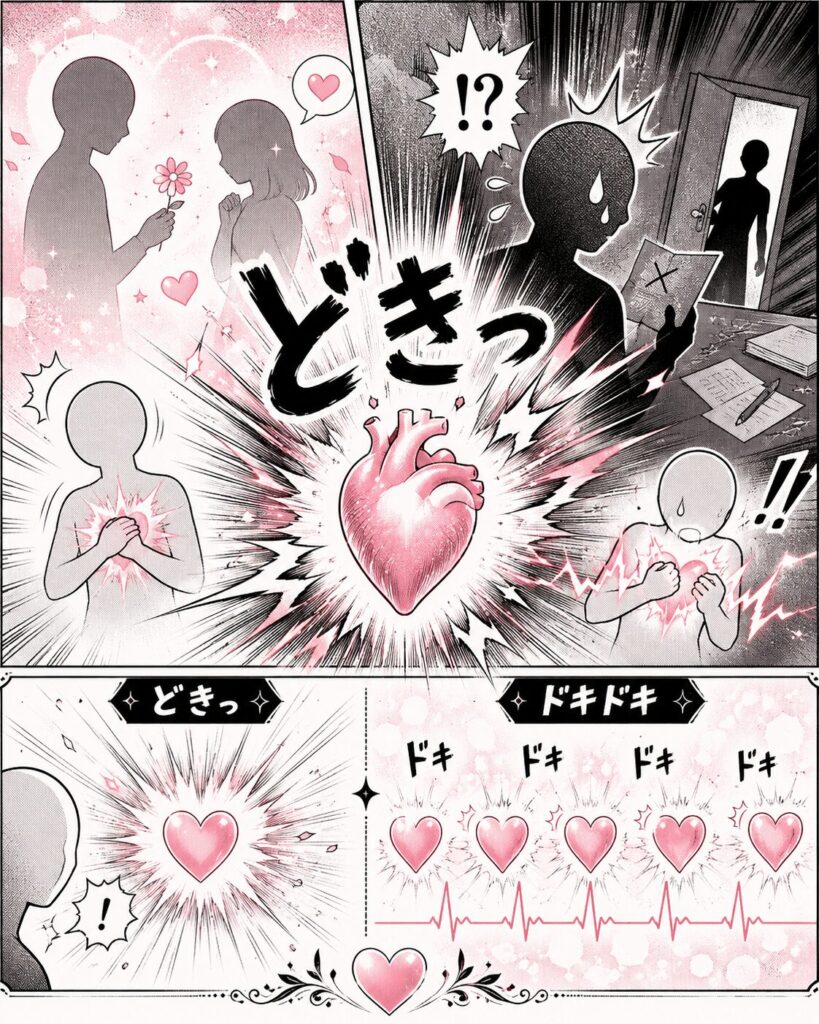
Doki is an onomatopoeia for that exact moment when your heart suddenly jumps.
And no, it doesn’t only mean simple surprise.
It can show all kinds of strong emotions hitting at once — romantic feelings, nervousness, panic, being shaken up, or that “oh no” feeling when your heart reacts before your brain catches up.
The biggest point is this: doki is momentary.
It’s not a feeling that keeps going for a long time. It’s that one instant when something inside you moves.
When is it used?
Romantic moments
Honestly, I don’t think it’s an exaggeration to say that doki is one of the most important onomatopoeia for romance in manga.
That’s how important it is.
Especially in shōjo manga, doki often marks the exact moment when a character suddenly becomes aware of someone in a romantic way.
Like when they:
- see that person smile
- notice unexpected kindness
- catch a side of them they’ve never seen before
- see them crying and feel their heart move
When doki appears in a panel like that, readers immediately feel it:
“Oh. Something changed just now.”
That’s why doki isn’t just a cute reaction.
It’s often a major sign that love is starting, or that a character’s feelings have shifted in a big way.
So if you see a doki panel, really look at it.
That moment often tells you what exactly made the character fall for the other person.
And honestly, this shows up in official fanbooks too.
Sometimes you’ll see relationship timeline features, where they go through how two characters got closer — and those pages often highlight panels with things like doki or kyun.
That’s not random. Those are the emotional turning points.
Also, when doki suddenly appears between two characters who didn’t seem romantically connected before, readers instantly start thinking:
- Wait, is this the start of a crush?
- Is this a romance flag?
- Are we heading into a love triangle?
- Is their friendship about to change?
Just by adding doki, the story suddenly opens the door to a new kind of relationship.
One important note, though:
doki is not usually used for simple “aww, that’s cute” feelings.
It’s more about the moment when someone becomes strongly aware of another person, and that awareness is often tied to romantic feelings.
So even if your pet is cute, or your little sibling does something adorable, that’s usually not where doki is used.
Anxiety, panic, and getting caught
But doki is not only for romance.
It’s also used for that moment of:
- “Oh no.”
- “Did they notice?”
- “I’m in trouble.”
- “That was way too close.”
For example:
“Wait… my pudding in the fridge is gone.” → doki
With just that, readers can immediately tell:
this person knows something.
Or maybe even: this person did it.
That’s why doki is also great for showing sudden guilt or panic without spelling it out.
It works really well in comedy, but it can absolutely appear in serious scenes too.
And this part matters a lot in manga:
the way “doki” is drawn can change the mood.
- If it’s round and bold, it can feel funny or exaggerated.
- If it looks shaky or scratchy, it can feel tense, dark, or serious.
So it’s not just the word itself.
The font and visual style can also tell you what kind of emotional moment this is.
③Doki vs. Doki-doki
At first glance, doki and doki-doki look really similar.
But in manga, they don’t do exactly the same job.
The easiest way to think about it is:
- doki = your heart jumps for one instant
- doki-doki = your heart keeps racing for a while
So if you suddenly see someone you like and your heart reacts in that exact moment, that’s doki.
But if you’re on a date with someone you like and your chest keeps pounding the whole time, doki-doki fits better.
So basically:
- doki = the trigger
- doki-doki = the continuing state
That difference is small, but really important.
FAQ
Is “doki” used in real-life conversation, or is it mostly a manga expression?
Most of the time, doki feels much more like a manga-style expression.
People don’t usually say it seriously in everyday conversation.
That said, friends or family might use it jokingly, especially when they’re being playful or dramatic.
For example:
“You didn’t take out the trash today, did you?”
“Doki.”
In that kind of situation, it works like a funny little admission of guilt.
But if you use it too naturally in real-life conversation, it can sound a bit too theatrical or too manga-like.
Is “doki” usually written as a sound effect, or can it also be spoken as dialogue?
Most of the time, doki is used as a sound effect.
That’s definitely the main way it appears.
But yes, sometimes it can also be spoken out loud as dialogue — especially when a character is joking around, acting dramatic, or lightly admitting that they got caught.
So while doki is mainly visual, it can occasionally show up in speech too.